
Dear wine lovers,
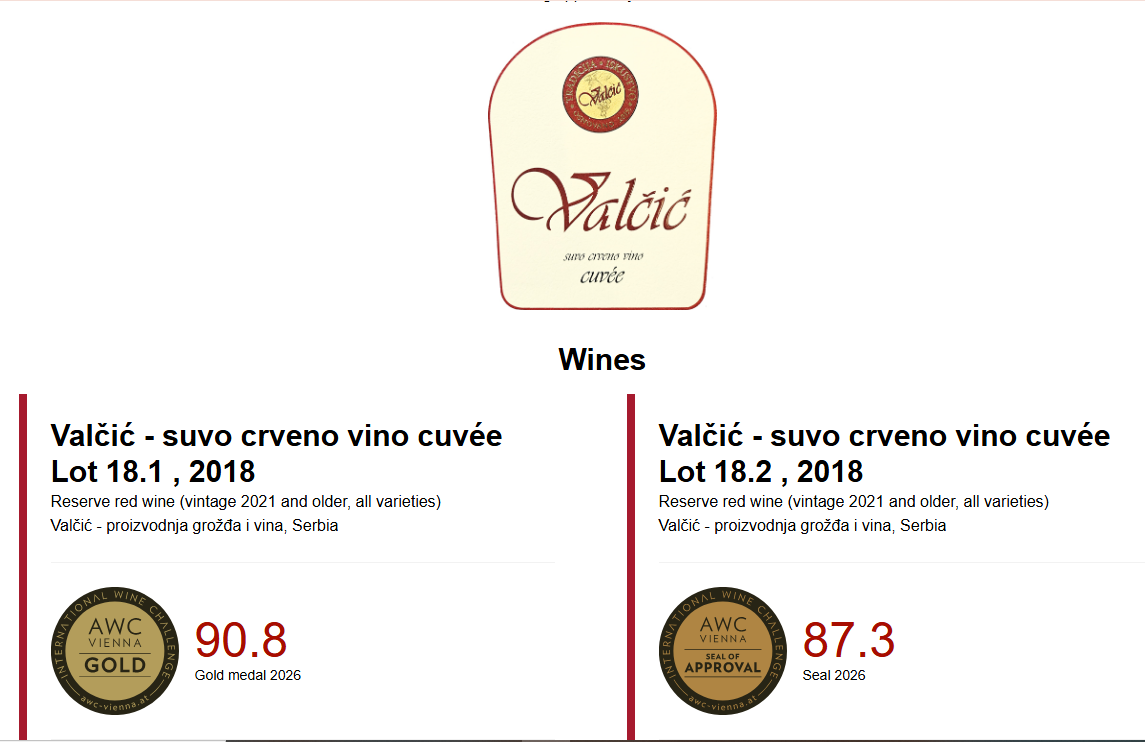
Welcome to the website www.vinarijavalcic. A layman would say that when the grapes that finish fermentation are harvested and the lees are drained, then there is less work in the vineyard and winery. Those of us who grow grapes and make wine from our own grapes know that there is never a moment of rest. Of course, a candied cherry as a decoration on a cake is certainly gold in Vienna (AWC Vienna, spring testing 2026; https://awc-online.awc-vienna.at/winery/2026/7754). . So in terms of novelty, a gold medal has been secured for this year, with every "vintage", starting in 2015 when we first went out into the world, up to now having been "golden" at least once.
We are introducing "archive" wines into our offer. They are Lot 17.1 (93 points, i.e. double gold in Slovakia) and Lot 18.1 (90.8 points in Vienna this year). Anyone who wants to have these wines in their wine shop should contact us.
From this year, more precisely with last year's harvest, we will try to make fortified wine. The base is our rosé, with some unfermented sugar and added grape distillate (grappa), up to 18%. It is kept for more than a year in open barrels. At the Zemun Wine Salon, this wine received a good response from those who tried it. The faces of the girls in particular spread into smiles at the first sip.
Let's continue with the wine stories. For this occasion, I would like to ask the question: What is it that we use our senses to look for in wine? It is generally accepted that there are ten basic characteristics of wine. These are: color, bouqet, balance, finesse, freshness, body, personality, strength, acidity and maturity.
The color of wine. When we meet a wine for the first time, and before we take the glass, we notice the color. Of course, the color can partly depend on the thickness of the column of wine in the glass, which is why some wines, when they are in thin glasses, have one (lighter) color. When they are in a larger vessel, the same wine has a different, often darker shade of color. This can be noticed with traminer or tamjanika, and you can check it in the glass when you look at the surface of the wine from the profile, the so-called meniscus, you will notice, for example, in tamjanika, a reddish note.
In general, the color of the wine has less importance compared to the flavors. However, when evaluating wine, color can be a significant and more or less underestimated indicator of quality because the pigments in wine are associated with the development, extraction and maturation of wine aromas. Color can provide information about the quality of a given year (harvest) and grape variety, intensity of aromas and methods of wine production and maturation. Of course, if it is natural pigments of grapes and wine.
Color is often an indicator of the amount of tannin, so such a deep and dark red color is the result of a higher amount of phenolic compounds. The acidity (bluish note) and aging (brown color) of the wine can also be judged by color.
The evaluation of wine colors, apart from the aesthetic approach, should be based on a good knowledge of wine chemistry. All red wines have natural pigments that are found in the membrane of the grape grain and/or in the pulp (flesh of the grain) and are genetically given to the given variety. Apart from this factor, the color is influenced by the selection of individual clones, the method of pruning and the application of fertilizers in the vineyard. In the winery, the wine production process should have the maximum impact on the potential of obtaining the desired wine color. In the end, the aging of the wine, both in terms of length of time and the conditions in the winery, has an effect on the color and therefore on the taste, aromas and smell of the wine.
Texts related to the colors of wine give us countless shades from malted colorless liquid to black wine. For the purposes of our "wine story", we will settle for basic colors that are not related to the grape variety but rather to the type of wine.
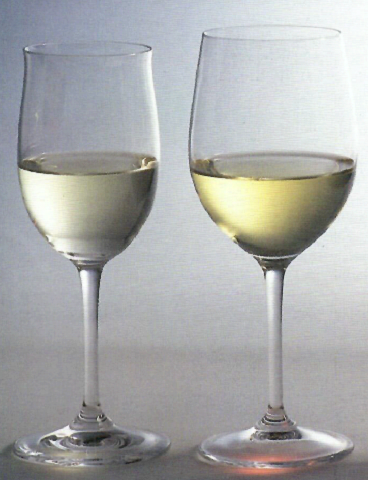
Left: Young fresh wine
Right: Older white wine; possibly barriquee
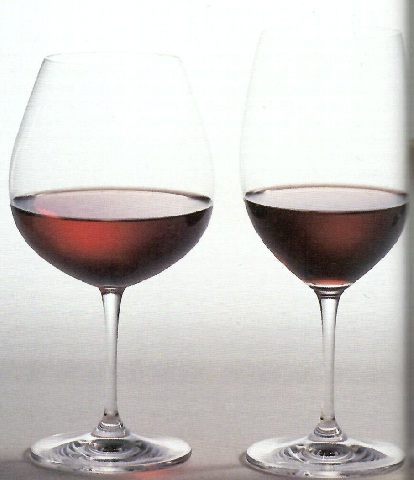
Left: Ruby color of an aged red wine, relatively ligh bodied
Right: Dark red, concentrated and aged wine
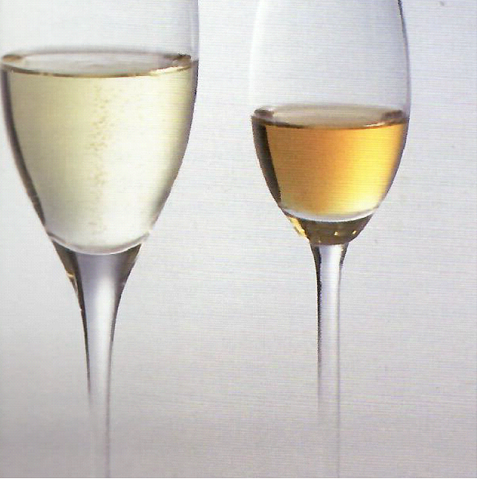
Left: Lively, delicate, effervescent white wine; young champagne
Right: The fascinating gold color of an aged dessert wine
In the next "Wine Story", and since there is a lot more to be said about the colors of wine, I will continue with the text. First of all, about the characteristics of the color of white, rose and red wines. Of course, that's how the story about the color of wine will end.
Cheers!